

Business intelligence exercises help you turn raw numbers into insights that actually matter. Instead of guessing what’s happening inside a business, you learn how to read the story hidden in data and use it to guide smarter decisions. When you practice these exercises, you don’t just improve technical skills. You train your mind to think analytically, spot patterns early, and connect data with real business outcomes.
In today’s data-driven world, organisations expect professionals to explain why something is happening, not just what happened. That’s where hands-on BI practice makes a difference. By working with dashboards, reports, and real datasets, you gain confidence in using data to support growth, reduce risk, and improve performance.
Introduction
Data is everywhere, but insight is rare. Many people collect reports without truly understanding them. Business intelligence bridges that gap by helping you analyse information and turn it into clear, actionable knowledge. Through structured practice, you learn how data flows through an organisation and how it supports decision-makers at every level.
What Are Business Intelligence Exercises?
Business intelligence exercises are practical activities designed to help you apply BI concepts using real or simulated data. Instead of learning tools in isolation, you work through scenarios that reflect real business problems. These tasks might include analysing sales data, building KPI dashboards, or identifying trends from historical records.
The goal isn’t just to master software. It’s to understand how data supports decisions. When you complete these exercises, you learn how to clean data, model it correctly, and present insights in a way others can understand. Over time, this hands-on approach strengthens your ability to think critically and explain findings with confidence.
Why Business Intelligence Exercises Matter
BI exercises matter because theory alone doesn’t prepare you for real-world challenges. In practice, data is messy, incomplete, and often confusing. Working through structured exercises teaches you how to handle these issues calmly and methodically.
They also improve decision-making. When you analyse data yourself, you start asking better questions. You learn to challenge assumptions, test ideas, and back up recommendations with evidence. This skill is valuable whether you’re a data analyst, manager, auditor, or business owner trying to make informed choices.
Key Skills Developed Through BI Exercises
Data Analysis Skills
These exercises strengthen your ability to explore datasets, recognise patterns, and understand relationships between variables. You learn how to break down complex information into manageable insights.
Critical Thinking and Problem Solving
By working through scenarios, you practise defining problems clearly and choosing the right analytical approach instead of jumping to conclusions.
Decision-Making Skills
BI practice helps you connect analysis with action. You don’t just report numbers; you interpret results and suggest next steps.
Data Visualization and Storytelling
Clear visuals matter. These exercises teach you how to design dashboards and charts that communicate insights quickly to decision makers.
Types of Business Intelligence Exercises
Data Cleaning and Preparation Exercises
Before analysis begins, data must be reliable. These exercises focus on fixing errors, handling missing values, and ensuring consistency.
Descriptive Analytics Exercises
You summarise historical data to understand what happened. Examples include monthly sales reports or customer activity summaries.
Diagnostic Analytics Exercises
Here, you dig deeper to understand why something happened, such as a sudden drop in revenue or customer engagement.
Predictive Analytics Exercises
These tasks help you forecast future outcomes using trends and statistical models.
Prescriptive Analytics Exercises
You explore scenarios and recommend actions, such as adjusting pricing or reallocating resources.
Common Business Intelligence Exercises with Examples
Practical examples make BI concepts easier to understand. Many professionals learn best by seeing how data applies to real situations.
For instance, analysing business data from public financial profiles can reveal how leadership decisions and growth strategies affect performance. Exercises like these help you understand how metrics connect to outcomes in the real world.
Sales Performance Analysis
Sales analysis exercises focus on revenue, customer acquisition, and channel performance. By tracking performance metrics such as monthly growth or conversion rates, you learn how to measure success and identify areas for improvement.
Customer Segmentation Analysis
These exercises teach you how to group customers based on behaviour or demographics. The insight helps businesses personalise marketing and improve satisfaction.
KPI and Dashboard Creation
Dashboard-building exercises show you how to track key performance indicators visually. This is where business intelligence tools truly add value.
Trend and Pattern Identification
By studying historical data, you practise trend analysis to uncover patterns in audience growth, digital engagement, or revenue streams.
Profitability and Cost Analysis
Profitability exercises focus on expenses, margins, and long-term sustainability. Using financial analysis, you learn how costs impact overall performance and where efficiencies can be gained.
How to Perform Business Intelligence Exercises Step by Step
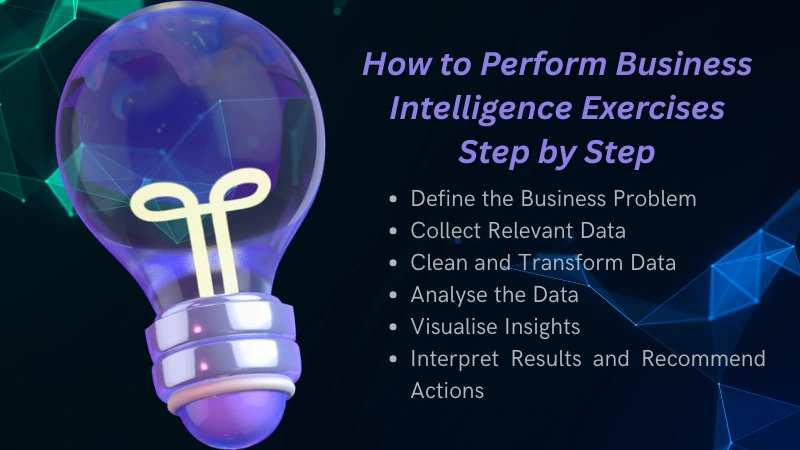
Define the Business Problem
Start with a clear question. A focused problem leads to meaningful insights.
Collect Relevant Data
Gather information from reliable sources such as CRM systems, databases, or surveys.
Clean and Transform Data
Fix errors, standardise formats, and prepare data for analysis.
Analyse the Data
Use BI tools to explore patterns and relationships.
Visualise Insights
Create charts and dashboards that communicate findings clearly.
Interpret Results and Recommend Actions
Explain what the data means and suggest next steps supported by evidence.
Tools Commonly Used for BI Exercises
Spreadsheet Tools
Excel and similar tools are great for basic analysis and quick calculations.
BI and Data Visualization Tools
Power BI, Tableau, Qlik Sense, and Google Data Studio help you build interactive dashboards and reports.
Database and Query Tools
SQL and relational databases allow you to retrieve and combine large datasets efficiently.
Advanced Analytics and AI Tools
Machine learning and predictive analytics tools expand BI capabilities beyond reporting.
Business Intelligence Exercises for Beginners
If you’re new to BI, start simple. Focus on understanding data structure and basic visualisation. Beginner-friendly tasks include analysing sales spreadsheets, creating simple dashboards, or practising SQL queries. These activities build confidence without overwhelming you.
Business Intelligence Exercises for Advanced Users
Advanced users can tackle larger datasets and complex models. Exercises might involve predictive analytics, real-time dashboards, or integrating multiple data sources. At this level, you’re not just analysing data; you’re designing systems that support strategic decisions.
Best Practices for Effective BI Exercises
Consistency matters. Always document assumptions, check data quality, and validate results. Keep dashboards simple and focused on key questions. Most importantly, align every exercise with a business goal so insights remain relevant.
Common Mistakes to Avoid in BI Exercises
Avoid focusing only on visuals without understanding the data. Don’t overload dashboards with unnecessary metrics. And never skip data cleaning, as poor data quality leads to misleading conclusions.
Real-World Use Cases of Business Intelligence Exercises
Retail and E-commerce
BI helps retailers forecast demand and optimise inventory.
Finance and Banking
Financial institutions use BI for risk assessment and fraud detection.
Healthcare
Hospitals apply BI to improve patient outcomes and efficiency.
Manufacturing
BI supports quality control and process optimisation.
Marketing and Sales
Marketers use BI to track campaigns and understand customer behaviour.
You can also explore regional market insights to see how data supports tourism demand forecasting and local economic analysis.
How BI Exercises Improve Business Decision-Making
When you practise BI regularly, you learn to rely on evidence instead of intuition. Data-driven decision-making reduces risk and improves confidence. Over time, these skills help you support strategic planning and long-term growth.
Future Trends in Business Intelligence Exercises
The future of BI includes more automation, real-time analytics, and AI integration. Exercises will increasingly focus on predictive models, machine learning dashboards, and data storytelling that connects insights with action.
Frequently Asked Questions
What are business intelligence exercises used for?
They help you practise analysing data and turning it into actionable insights.
Are BI exercises only for data analysts?
No. Managers, auditors, and marketers also benefit from BI skills.
What tools are best for practising BI exercises?
Power BI, Tableau, SQL, and spreadsheet tools are popular choices.
How often should businesses perform BI exercises?
Regularly. Ongoing analysis helps organisations stay responsive.
Can BI exercises improve small business performance?
Yes. Even small datasets can reveal valuable insights.
What is the difference between BI exercises and data analytics exercises?
BI focuses more on reporting and decision support, while analytics often goes deeper into modelling.
Are BI exercises useful for students and beginners?
Absolutely. They provide hands-on experience and build confidence.
Conclusion
Consistent practice with business intelligence exercises helps you grow from simply reading reports to truly understanding them. Each task, from cleaning data to building dashboards, strengthens your ability to explain what’s happening and why it matters. Over time, these skills support better decisions, stronger strategies, and measurable business success.
Whether you’re building a portfolio, improving performance at work, or exploring a new career path, BI practice gives you a clear advantage. Data tells a story. When you know how to listen, you can help shape the future of any organisation.